
PNG vs JPG vs WebP vs AVIF: Which Image Format Should You Use? (2026 Guide)
Learn the differences between PNG, JPG, WebP, and AVIF image formats. Compare quality, compression, transparency, browser support, and discover which format is best for websites, social media, photography, and SEO in 2026.
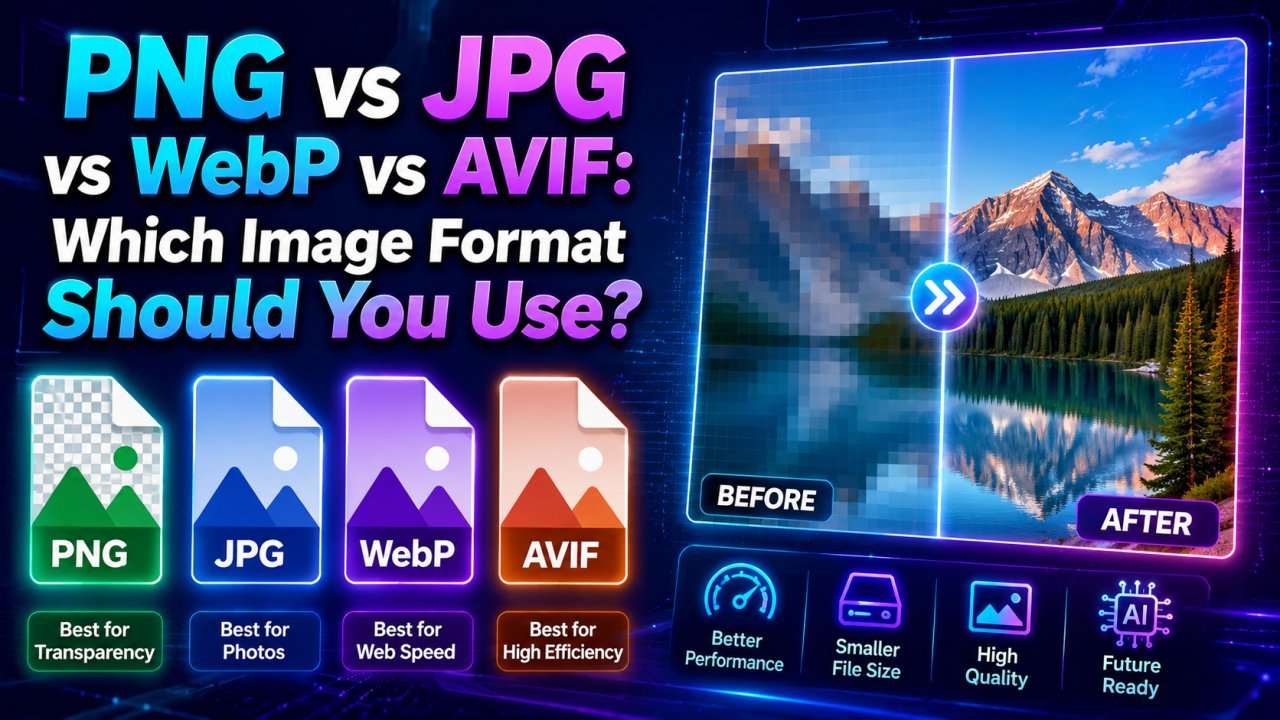
PNG vs JPG vs WebP vs AVIF: Which Image Format Should You Use? (2026 Guide)
Choosing the right image format can significantly impact your website's speed, image quality, SEO, and user experience. Whether you're uploading product photos, blog images, logos, or social media graphics, selecting the correct format helps reduce file sizes while maintaining visual quality.
The four most common image formats today are PNG, JPG (JPEG), WebP, and AVIF. Each has unique strengths and weaknesses, making them suitable for different purposes.
In this comprehensive 2026 guide, we'll compare PNG, JPG, WebP, and AVIF in terms of quality, compression, transparency, browser compatibility, performance, and best use cases. By the end, you'll know exactly which format to choose for every situation.
Why Does Image Format Matter?
Images often account for the largest portion of a webpage's size. Large files slow down websites, increase bandwidth usage, and negatively affect SEO and user experience.
Using the right image format helps you:
- Improve page loading speed
- Enhance Core Web Vitals
- Boost SEO rankings
- Save storage space
- Reduce bandwidth costs
- Improve user experience
- Maintain excellent image quality
What is JPG (JPEG)?
JPEG (Joint Photographic Experts Group) is one of the oldest and most widely used image formats. It uses lossy compression, meaning some image data is permanently removed to reduce file size.
Advantages
- Small file size
- Supported by every browser and device
- Perfect for photographs
- Easy to share online
Disadvantages
- No transparency support
- Quality decreases after repeated editing
- Compression artifacts may appear
Best For
- Photography
- Blog images
- Social media photos
- Website banners
- Travel images
What is PNG?
PNG (Portable Network Graphics) is a lossless image format designed to preserve image quality while supporting transparent backgrounds.
Unlike JPG, PNG keeps every detail of the original image.
Advantages
- Supports transparency
- High-quality graphics
- Perfect for logos
- Sharp text and icons
- Lossless compression
Disadvantages
- Larger file sizes
- Slower loading compared to WebP or AVIF
Best For
- Logos
- Transparent backgrounds
- UI elements
- Infographics
- Icons
- Screenshots
What is WebP?
WebP is Google's modern image format designed to replace JPG and PNG on websites.
It supports both lossy and lossless compression while producing significantly smaller file sizes.
Advantages
- Smaller files than JPG
- Supports transparency
- Excellent quality
- Faster website loading
- Better SEO performance
Disadvantages
- Older software may not support it
- Some legacy browsers have limited compatibility
Best For
- Blogs
- Websites
- eCommerce
- Landing pages
- Product images
- Marketing graphics
What is AVIF?
AVIF (AV1 Image File Format) is the newest generation of image formats. It offers even better compression than WebP while maintaining outstanding image quality.
Many modern websites now use AVIF to maximize page speed.
Advantages
- Smallest file sizes
- Outstanding image quality
- HDR support
- Transparency support
- Excellent compression
Disadvantages
- Slightly slower encoding
- Older software may not support editing
- Some legacy browsers may require fallback images
Best For
- High-performance websites
- Modern web applications
- Photography
- Image-heavy websites
- SEO optimization
PNG vs JPG vs WebP vs AVIF: Quick Comparison
| Feature | JPG | PNG | WebP | AVIF |
|---|---|---|---|---|
| Compression | Lossy | Lossless | Lossy & Lossless | Advanced Lossy & Lossless |
| Image Quality | Good | Excellent | Excellent | Outstanding |
| File Size | Small | Large | Very Small | Smallest |
| Transparency | ❌ No | ✅ Yes | ✅ Yes | ✅ Yes |
| Animation | ❌ No | ❌ No | ✅ Yes | ✅ Yes |
| Browser Support | Excellent | Excellent | Excellent | Good (Modern Browsers) |
| Best For | Photos | Logos & Graphics | Websites | Next-Generation Websites |
PNG vs JPG
One of the most common questions is whether to use PNG or JPG.
Choose PNG if:
- You need a transparent background.
- You're working with logos or icons.
- The image contains text.
- Image quality is more important than file size.
Choose JPG if:
- You're uploading photographs.
- Smaller file sizes matter.
- Transparency isn't required.
- You're sharing images online.
Winner:
- Photos → JPG
- Graphics → PNG
WebP vs PNG
WebP was designed to improve website performance while maintaining excellent image quality.
Compared to PNG, WebP usually reduces file size by 25–35% without noticeable quality loss.
Use WebP for:
- Website images
- Product photos
- Blog images
- Landing pages
- Marketing banners
Use PNG for:
- Logos
- Transparent graphics
- UI design
- Icons
For most websites, WebP is the better option because it loads faster and improves Core Web Vitals.
AVIF vs WebP
AVIF is the newest image format and offers even better compression than WebP.
In many cases, AVIF images are 20–40% smaller than WebP while maintaining similar or even better visual quality.
Choose AVIF if:
- Website speed is your highest priority.
- You want maximum compression.
- You target modern browsers.
- You optimize for SEO.
Choose WebP if:
- You need broader compatibility.
- You want faster image processing.
- You use older editing software.
For future-ready websites, AVIF is becoming the preferred choice.
Which Image Format is Best for SEO?
Google recommends optimizing images to improve page speed and user experience.
Smaller image files help:
- Improve Core Web Vitals
- Reduce bounce rates
- Increase PageSpeed Insights scores
- Improve mobile performance
- Lower bandwidth usage
SEO Ranking
- AVIF ⭐⭐⭐⭐⭐
- WebP ⭐⭐⭐⭐☆
- JPG ⭐⭐⭐☆☆
- PNG ⭐⭐☆☆☆
While image format alone won't improve rankings, faster-loading pages create a better user experience, which supports SEO efforts.
Which Format Loads the Fastest?
Approximate comparison for the same image:
| Format | Relative File Size |
|---|---|
| PNG | 100% |
| JPG | 45–60% |
| WebP | 30–45% |
| AVIF | 20–35% |
Smaller files mean faster page loads, especially on mobile devices.
Best Image Format for Different Use Cases
Photography
✅ JPG
Photographs contain millions of colors and benefit from JPEG's efficient compression.
Website Images
✅ WebP
WebP provides excellent quality while significantly reducing file size.
Logos
✅ PNG
Transparent backgrounds make PNG ideal for branding materials.
Blog Images
✅ WebP
Blog posts benefit from faster loading times without sacrificing image quality.
Social Media
✅ JPG
Most social platforms automatically compress uploaded images, making JPG a practical choice.
eCommerce Products
✅ WebP
Online stores often display hundreds of images. Using WebP helps pages load faster while keeping products sharp.
Transparent Images
✅ PNG or AVIF
If transparency is required, avoid JPG.
Common Mistakes to Avoid
Many people unknowingly choose the wrong image format.
Avoid these common mistakes:
- Uploading large PNG photos to your website.
- Saving logos as JPG.
- Using AVIF without providing browser fallbacks when necessary.
- Uploading images without compression.
- Ignoring image dimensions.
- Exporting screenshots as JPG instead of PNG.
- Using oversized images that browsers must resize.
Choosing the right format from the start saves storage space and improves website performance.
Ready to optimize your images?
Every tool mentioned in this article is free to use. No upload, no signup, and no watermarks — ever.
Try our free toolsRelated articles
How to Compress Images Without Losing Quality (2026 Guide)
Reduce image file sizes without sacrificing quality. Learn the best image compression techniques, free online tools, and expert tips to optimize JPG, PNG, WebP, and AVIF images for faster websites in this complete 2026 guide.
How to Resize Images Online Without Losing Quality (2026 Guide)
Learn how to resize images online without losing quality using free AI-powered tools. Discover the best methods, image dimensions, resizing tips, and SEO best practices for JPG, PNG, WebP, and AVIF im
How to Reduce Image Size in KB Without Losing Quality
Learn how to reduce image size in KB without losing quality using smart compression, resizing, format selection, and practical image optimization techniques.